· Timothy O'Brien
Talk to Your Agents
Dictation is the fastest channel into a fleet of agents, and the return-to-office mandate is optimized for the keyboard.
Talk to Your Agents
Dictation is the fastest way to direct a fleet of agents, and the return-to-office mandate is optimized for the keyboard.
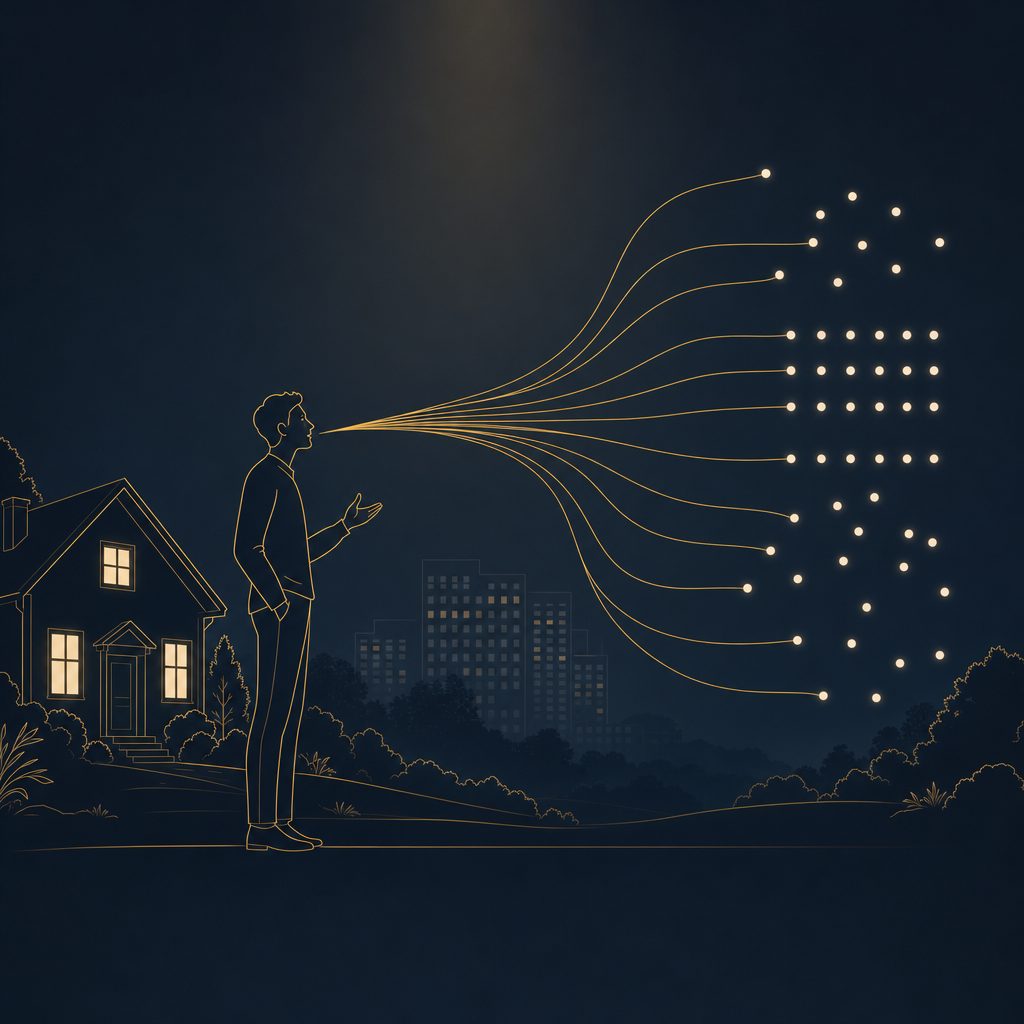
I will spend most of today typing, and typing will be the slowest thing I do. That is not a complaint about my keyboard. It is an observation about the work: when the work is orchestration, the sentences that matter get spoken, not typed.
Everyone I talked to this week agrees on the premise. Typing instructions to an agent is a drag. The people who say nobody types anymore are wrong — I type all day, partly because I sit in an office — but the people doing the fastest agent work have stopped treating the keyboard as the main channel. They dictate. They talk through priorities while the agents read, they review out loud what the agents built overnight, and they move on to the next thread while the typing version of themselves would still be composing the first message.
Here is the pattern I keep hearing. An engineer runs agents overnight. The agents finish something. The engineer stays home for half a day, puts on headphones, and dictates feedback on what already happened: what to keep, what to redo, what to hand to the next agent. By the afternoon the fleet is working again and the engineer is back in a meeting they could not skip. Nobody wrote a ticket for any of this. Nobody opened a project plan. The feedback loop is voice, and the loop closes in hours instead of days.
My own number, from my own weeks of working this way: I get about five times more done talking to a series of agents than typing the same instructions. That is my experience, not a benchmark. But the reason is structural. Speech is roughly two to three times faster than typing, and orchestration is mostly instruction and judgment — the exact material that does not need a keyboard. Voice turns orchestration into a conversation. Typing turns it into correspondence.
The tools have caught up faster than the offices have. Claude has had a spoken voice mode on mobile since 2025, and Claude Code — the terminal, the place where working engineers actually live — added voice mode this past March (announced in March 2026); you turn it on with /voice and talk your way through refactors. The dictation layer is a category now. On the Mac, Muesli is the one people keep telling me to look at: open source, runs its transcription locally on Apple Silicon, and does dictation and meeting transcription in one app, in the spirit of Wispr Flow and Granola without sending your voice to a server. Push a key, talk, and the text lands wherever your cursor is — including inside a terminal session with an agent.
Now put that next to the return-to-office mandate. The mandate assumes the work looks the same from anywhere: a person, a screen, a ticket queue. Most office policy was designed by and for people whose work is still the old shape — writing software by hand, going to meetings about software, updating trackers, building project plans. That is still most people. But the workforce is splitting into two groups inside the same building, and only one of them is orchestrating. For that group, the shared office is the single worst place to work, because the best interface they have is their voice, and an open floor turns every dictated review into a broadcast. So they put headphones on and type. The office takes the fastest channel away and hands back the slow one.
I am not against offices, and I am not predicting the end of them. I am pointing at a mismatch that nobody is designing around. If the most productive agent-work you do happens at home because that is where you can talk out loud, then a mandate that pulls you into the building is managing attendance, not output. If a company wants the orchestrator-shaped people in the building, it needs phone booths and small rooms, the modern equivalent of the desk.
I am writing about voice as the orchestrator’s interface in the book, because the interface question decides who can do this work. The people still typing instructions by hand are not slow. They are working in an office that was built to make typing the only option. The ones who stayed home for half a day to talk to their agents already know what the next few years of work sound like. It sounds like someone thinking out loud, alone, in a quiet room, moving five times faster than the meeting down the hall.
Newsletter
Get the notes by email
New essays and chapter updates, a few times a month. No spam — unsubscribe any time.