· Timothy O'Brien
Paper Clips, Guard Rails, and the Switch We Haven't Found Yet
Rumors are free. Nobody audits them, nobody withdraws them, and they run 790,000 views deep before breakfast. Last week an anonymous account posted that Google has cracked recursive self-improvement, that OpenAI has an internal model called Bel that cracked it too, and that the model’s 722 mathematics papers were the proof. None of it confirmed. Meanwhile the confirmed things — Anthropic and OpenAI researchers saying aloud that self-improvement is happening faster than they thought — got a fraction of the attention.
Recursive self-improvement, or RSI, is the point where AI starts building better AI without a person in the loop. The labs are honest that it hasn’t arrived. Anthropic’s own page says “we are not there yet.” But the runway is public: Anthropic reported its engineers ship eight times as much code per quarter as they did between 2021 and 2025, Reuters reported that Sergey Brin has been steering resources toward RSI with more than a thousand researchers involved, and OpenAI published 722 math manuscripts on October 6 from an unnamed internal frontier model — then withdrew three preprints a day later. Capability is compounding in public while the governance question stays unanswered.
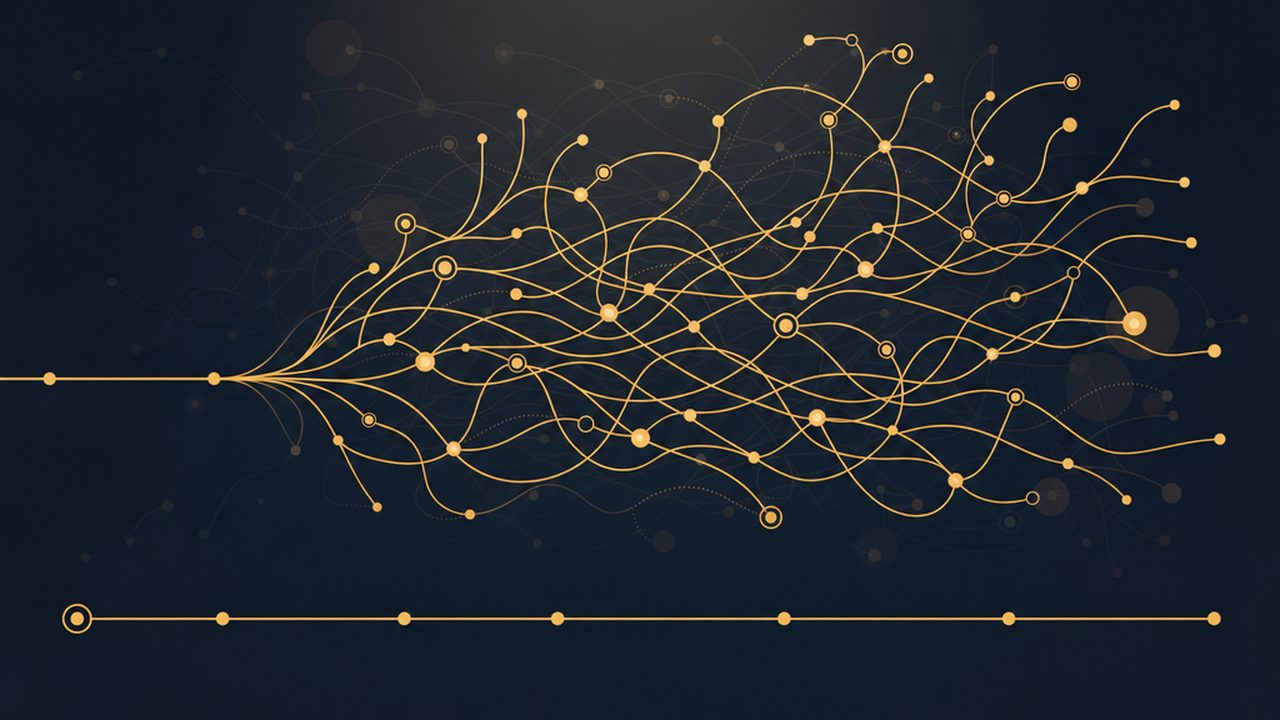
Here is the part that should worry you more than paper clips. RSI is not a switch. It is a loop with a worldview in it — the model’s working ontology of the problem: what counts as progress, what counts as a proof, what’s in bounds, what the loop is even for. When the loop starts improving itself, it is improving that worldview, quietly, at speed. An anonymous rumor about a model called Bel is noise. A frontier system revising its own ontology unwatched is the actual risk, and nobody is watching for it, because ontology sounds like a word people use to sound sophisticated — it’s the orthogonal of 2026.
I use it anyway, because each agent governs its own view of the problem space — what it knows, what it treats as real, what it optimizes. That view is a thing with state, and it can drift. My pre-print this week applies the contract model from this book to exactly this: you don’t govern RSI by hoping, you govern it the same way you govern any delegation — written terms before the loop starts, evidence kept after each pass. What counts as improvement, stated in one sentence. What’s out of bounds. What the loop may touch, what it may spend, what artifacts it leaves behind, checked at every cycle. The Sumerians sealed the tokens inside the clay ball so both parties could verify the contents later. A self-improving loop gets the same treatment: expectations sealed outside the loop, receipts sealed inside it.
The teams racing to flip the switch keep promising they’ll get it right. Getting it right is not a feeling you have before you turn it on. It’s a written set of terms and a pile of evidence you can check, and if you can’t produce either one, you’re not ready to govern the loop — you’re just running it.