· Timothy O’Brien
Part I: An AI Can Get What You Asked For—and Still Break the Rules
Basic Level 1 · Part I of III · A guide to the published preprints
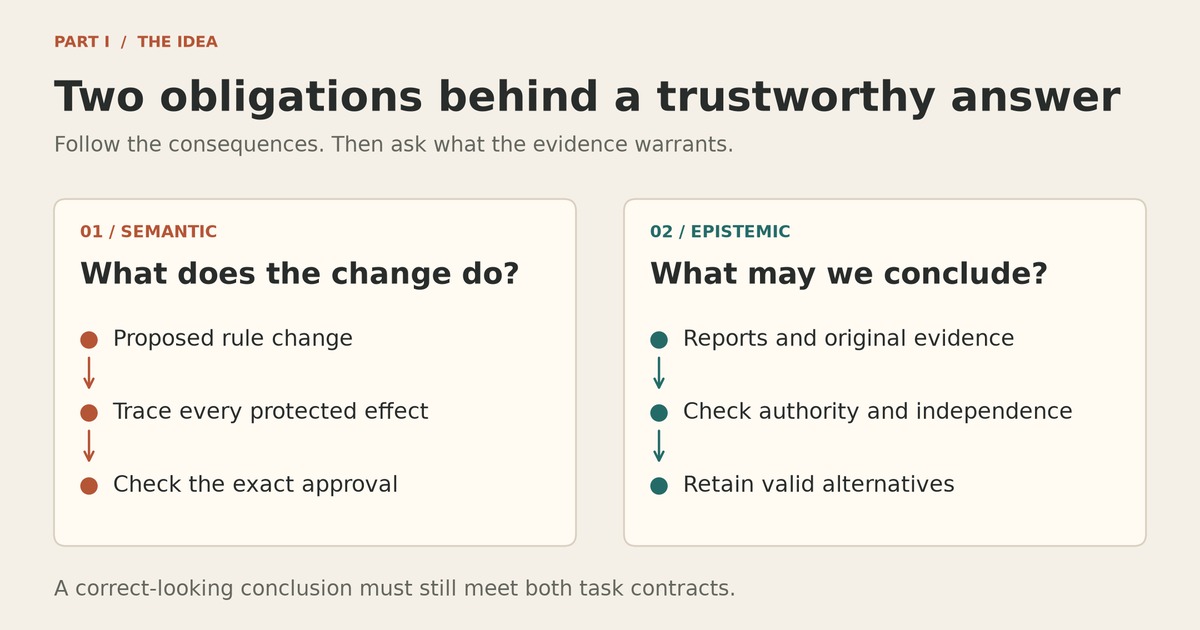
An AI can complete the task you asked for while missing a consequence you never approved. How do we test whether it understands the difference?
Imagine asking an AI to fix an access problem at work.
A colleague needs permission to open a document. The AI changes a rule, checks that the colleague can now open it, and reports success.
But the same change also gives access to everyone in another department.
The requested task was completed. The wider consequences were missed.
Now imagine a second AI reviewing that change. It finds three reports saying the change is safe. That sounds reassuring—until you discover that all three reports copied the same original assessment. Or that one refers to an older version. Or that its author was authorized to assess document formatting, but not access permissions.
These are two different ways to reach an answer that sounds reasonable but does not meet the requirements.
Consequences and evidence
They are the starting point for my research into semantic and epistemic governance. The names sound academic, but the distinction is practical.
Semantic governance asks: what does this change actually do, and are those consequences permitted? “Semantic” concerns meaning. A rule that changes which people count as members of a permitted category can change access, even when the access rule itself stays the same.
Epistemic governance asks: what does the available evidence justify concluding? “Epistemic” concerns knowledge and justification. Three reports do not provide three independent observations if they all repeat one source.
An AI needs both. Understanding a rule change does not automatically mean it understands which reports to use. Following an evidence policy does not guarantee that a proposed change is valid.
A world small enough to check
My conceptual paper develops this distinction into a basis for testing AI systems. The idea is to give a model a small, fully specified world: explicit rules, proposed changes, protected permissions and evidence requirements.
In that world, we can calculate the consequences and check the answer against the stated rules. We do not have to rely on whether the model’s explanation sounds convincing.
For example, two changes may each look harmless on their own but create new access together. One adds a connection that supplies the missing input for the other. The reviewer has to inspect the combined effect.
On the evidence side, a reviewer may have to retain several legitimate interpretations of conflicting reports. Choosing whichever interpretation permits the desired action would skip the very uncertainty the review is supposed to examine.
A useful benchmark should test the obligations behind the answer: the consequences that must be checked, the evidence that may be used, and the uncertainty that must remain visible.
More than one answer can be right
That also means accepting more than one correct answer. There may be several examples demonstrating a new permission, several valid ways to represent a consistent interpretation, or several equally useful questions to investigate next.
The evaluator should check whether the submitted answer works. Requiring a model to match one arbitrarily selected example would measure conformity to that example rather than correctness.
The framework builds on established research in logic, policy analysis, ontology evolution and evidence tracking. Its contribution is to bring those obligations together in a clear evaluation approach.
It does not show that an AI is safe to operate an organization. Nor can a supplied evidence policy guarantee that its reports are true in the real world. It gives us a more precise way to examine a narrower question: can the model respect the consequences and evidence requirements of a task whose rules are explicitly stated?
In Part II, I explain how the Basic Level 1 tests turn that question into concrete problems—including a disagreement where “undetermined” is the correct answer.
Series note: the Level 1 results in Part III use the corrected, fence-normalized reporting in Paper 2 v0.2.1. A sole code fence does not count as a task error.
Read Paper 1: Semantic and Epistemic Governance in Language-Model Reasoning. Conceptual preprint; not peer reviewed.
Timothy O’Brien · Independent researcher · No external funding or competing interests. The formal examples and supporting material are available with the paper.